What is market research? Examples and best practices
Launching a product without market research is like navigating a city without a map. You might eventually get where you're going, but you'll waste time, money, and energy on wrong turns that could've been avoided.

Market research is the process of gathering, analyzing, and interpreting information about a market—who's in it, what they want, how they behave, and what competitors are doing. It's the foundation for decisions about pricing, positioning, product development, messaging, and growth strategy.
For business owners, marketers, and product teams, understanding market research isn't just helpful—it's the difference between guessing and knowing. This guide covers what it is, how it works in practice, and how to do it well.
Market research defined
At its core, market research answers two questions: "Is there a market for what I'm offering?" and "How do I reach the people in it?"
That sounds simple, but those questions contain layers. Understanding whether a market exists means understanding the size of the opportunity, the needs of potential customers, and whether those needs are already being met by someone else. Understanding how to reach people means understanding their behavior, preferences, communication channels, and decision-making process.
Market research produces this understanding through systematic data collection—surveys, interviews, observation, competitive analysis, and secondary data sources. The emphasis on "systematic" matters. Reading a few product reviews or browsing a competitor's website is useful, but it's not research. Research is deliberate, structured, and designed to minimize the biases that casual observation can't avoid.
Types of market research
Market research divides into several categories, each suited to different questions and stages of business development.
Primary research
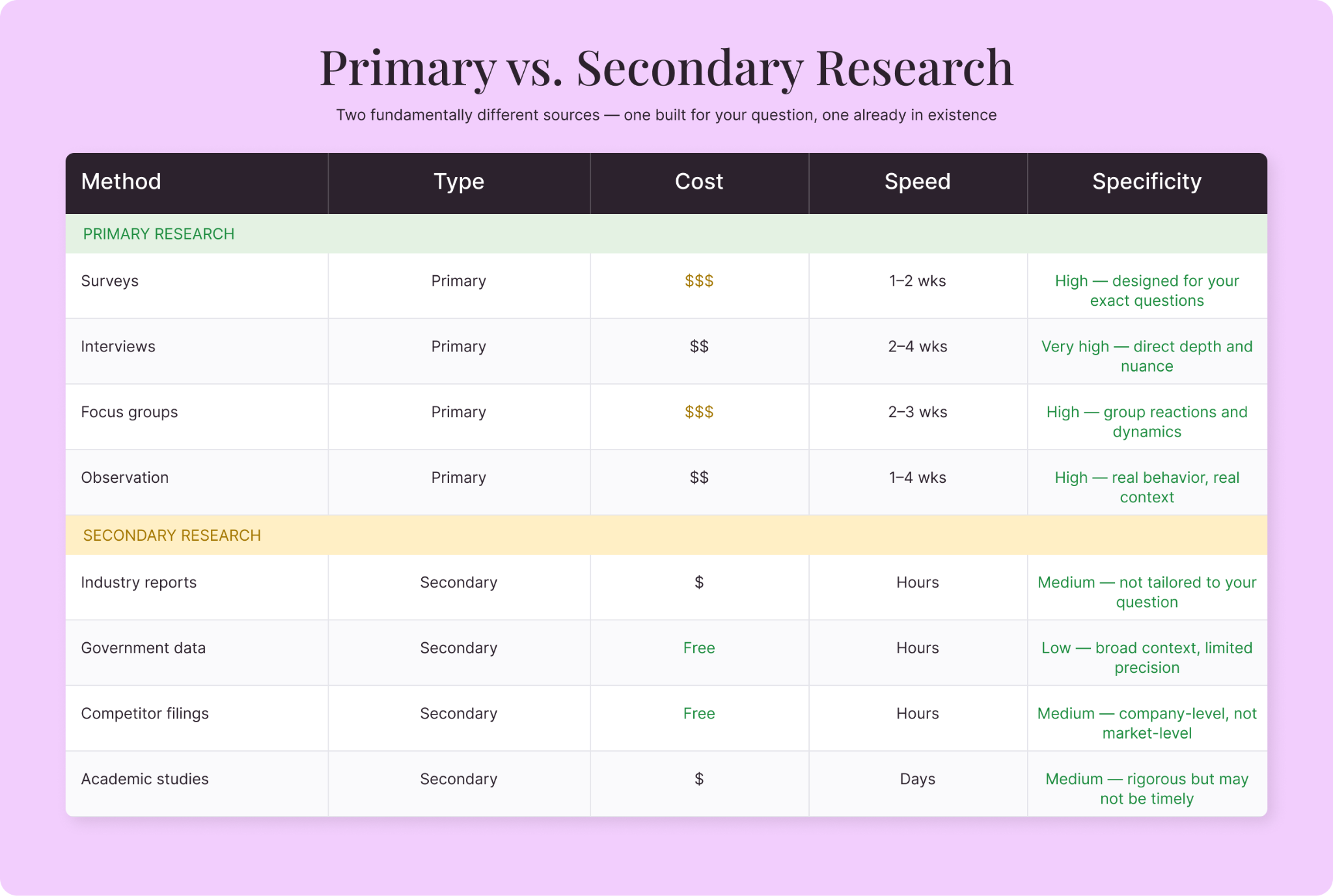
Primary research is data you collect yourself, designed specifically to answer your questions. You control the method, the audience, and the scope.
Common primary research methods include:
- Surveys collect quantitative data from a large audience on preferences, behaviors, or attitudes
- Interviews provide qualitative depth from individual conversations about motivations, frustrations, and decision-making
- Focus groups facilitate group discussions that surface diverse perspectives and reactions to concepts, products, or messaging
- Observation involves watching how people behave in real environments (retail stores, websites, events) without interfering
Primary research is more expensive and time-consuming than secondary research, but it's tailored precisely to your needs.
Secondary research
Secondary research uses data that already exists—published reports, government statistics, industry analyses, academic studies, and competitor filings. It's faster and cheaper than primary research, and it provides context that helps you frame your primary research more effectively.
Good secondary sources include industry associations, government census data, trade publications, financial filings, and reputable research firms. The limitation is that secondary data was collected for someone else's purpose, so it may not align perfectly with your questions.
Exploratory research
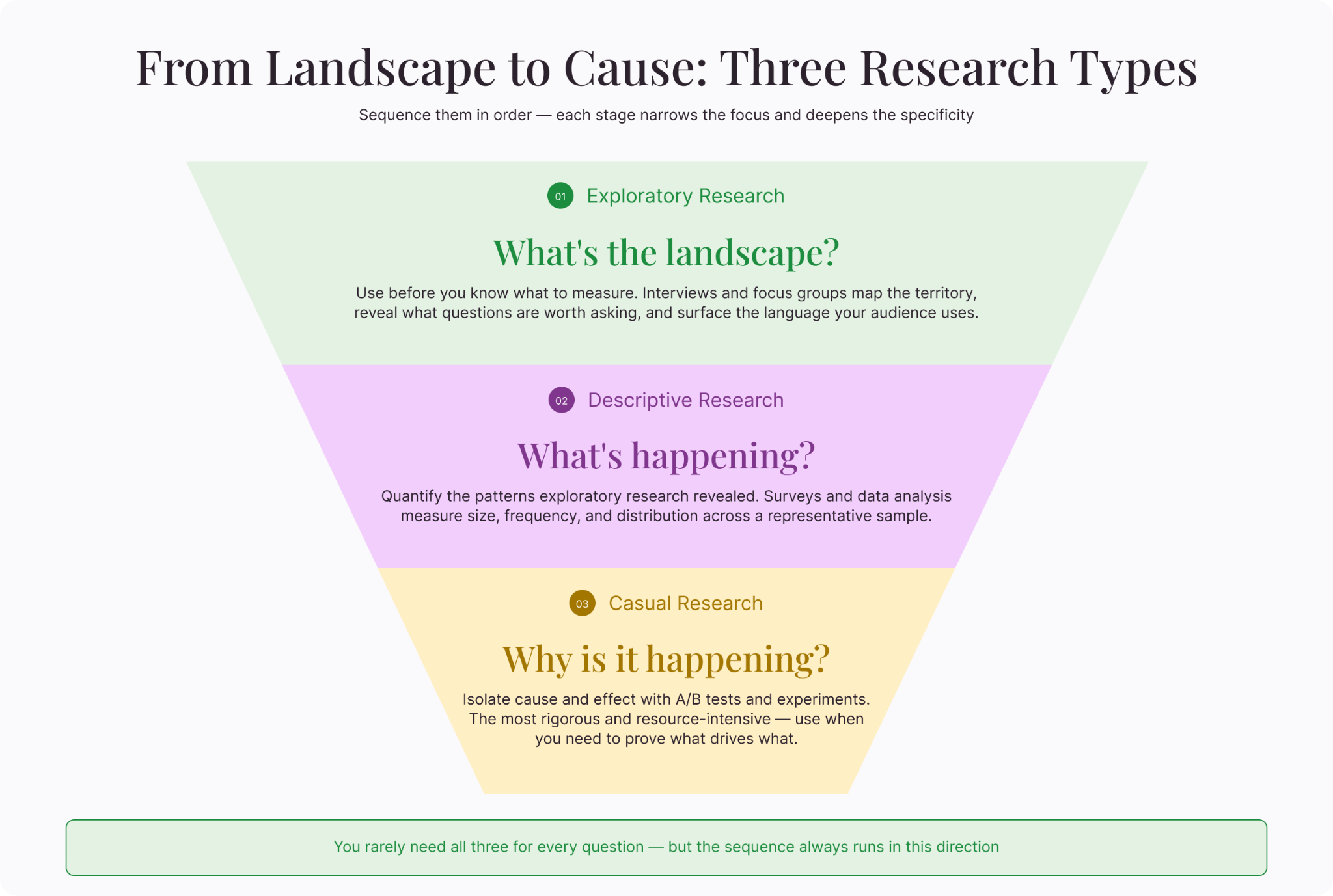
Exploratory research happens at the beginning of a project, when you're still defining the problem. The goal isn't to answer questions definitively but to understand the landscape well enough to ask better questions. Interviews and focus groups are typical exploratory methods.
Descriptive research
Descriptive research quantifies what's already happening. How large is the market? What's the demographic breakdown of buyers? What's the average purchase frequency? Surveys and data analysis are the standard tools.
Causal research
Causal research investigates cause and effect. Does a price decrease actually increase sales? Does a specific ad campaign drive brand awareness? Experiments and A/B tests provide causal evidence that other methods can't.
Market research in action: examples
Abstract definitions only go so far. Here's how market research looks in practice across different scenarios:
Example 1: Validating a new product idea
A food delivery startup wants to launch a meal-kit subscription targeting busy professionals. Before investing in product development, they conduct market research in three stages.
First comes secondary research: they review industry reports on the meal-kit market (size, growth rate, major players) and analyze competitor pricing, positioning, and customer reviews to identify gaps.
Second, exploratory interviews: they talk with 15 busy professionals about their cooking habits, pain points with existing meal services, and what would make them switch. They learn that flexibility—skipping weeks without penalty—is the most requested feature across conversations.
Third, a quantitative survey: they survey 500 professionals in their target demographic to validate the interview findings across a larger sample. The survey confirms that 68% of respondents consider flexible scheduling "very important" when choosing a meal-kit service.
The research gives them a validated product concept, a clear differentiator (flexibility), and quantitative evidence to support their pitch to investors.
Example 2: Entering a new geographic market
A software company based in the U.S. is considering expanding to Germany. Their market research includes demographic analysis (how many businesses in their target segment operate in Germany), regulatory review (data privacy requirements under GDPR), competitive analysis (which local and international competitors already serve this market), and customer interviews with German businesses in their target segment to understand buying behavior and communication preferences.
The research reveals that while market size is attractive, local competitors offer German-language support and GDPR-compliant hosting that the U.S. company currently lacks. This shapes their go-to-market strategy: they prioritize localization and a European data center before launch.
Example 3: Repositioning an existing product
A project management tool discovers through net promoter score surveys that small business users love their product but enterprise users find it too basic. Market research—a combination of competitive analysis and enterprise user interviews—reveals that the missing elements are advanced permissions, audit logs, and single sign-on integration.
Rather than building features for every user, they create an enterprise tier with the specific capabilities this segment needs. The research prevented them from guessing which features to build and ensured the investment targeted real demand.
Best practices for effective market research
Good research depends on good process. These practices can help you get more value from every study you run.
Start with clear objectives
The most valuable market research is focused research. "Tell me everything about our market" produces a pile of data with no clear implications. "What's the willingness-to-pay among mid-market SaaS companies for our premium tier?" produces an actionable answer.
Define your objectives before choosing a method. Know what decision the research will inform. If you can't connect a research question to a business decision, it's probably not worth asking.
Combine methods
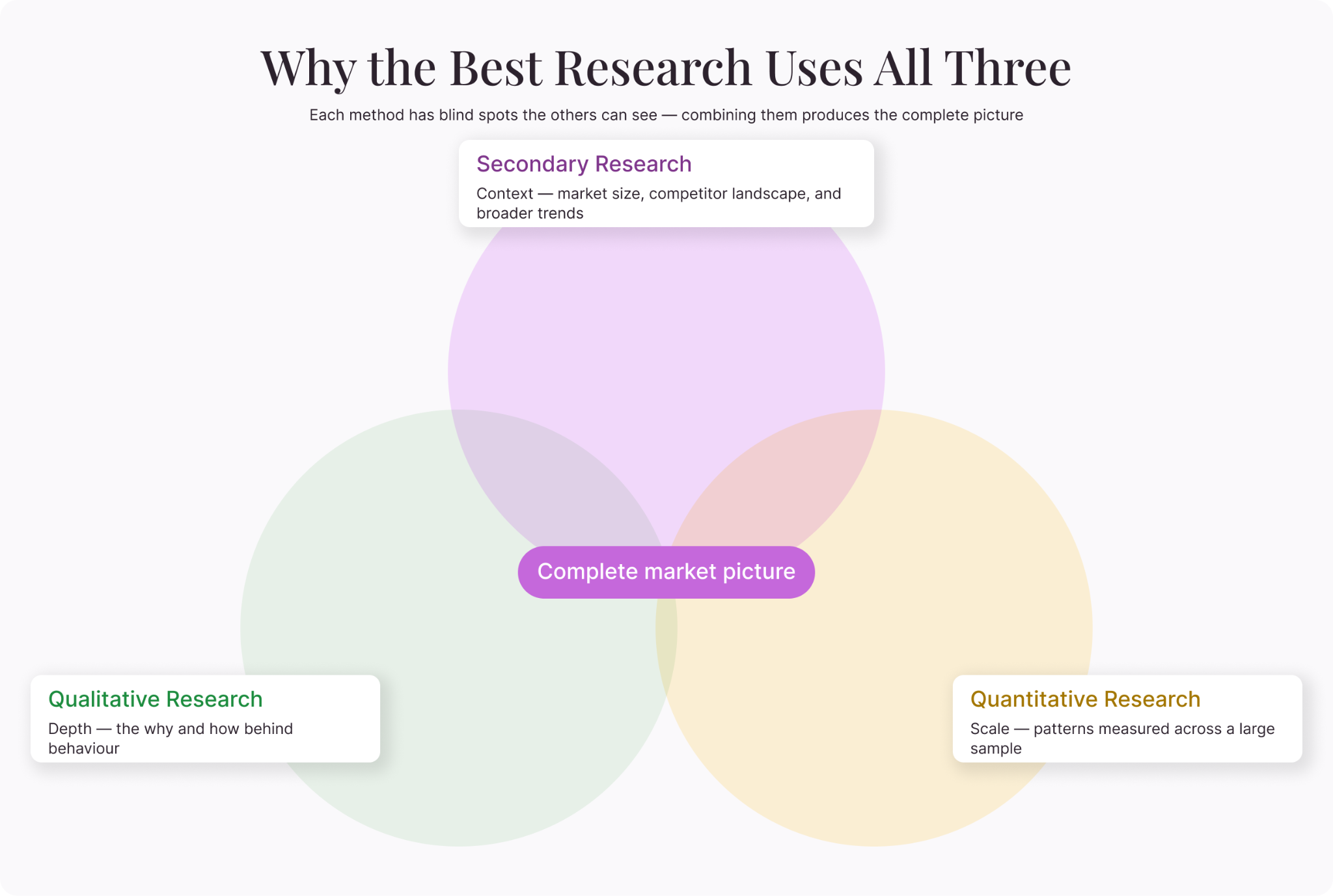
No single method tells the full story. Secondary research provides context. Qualitative research provides depth. Quantitative research provides scale. The strongest market research combines at least two of these, with each method compensating for the others' blind spots.
Know your sample
Who you study matters as much as how you study them. If your survey reaches only existing customers, you're missing the perspective of people who haven't bought from you yet, including those who considered you and chose a competitor. Define your target population carefully and choose a sampling method that reaches them.
Watch for bias
Confirmation bias is the biggest threat to market research. If you're already excited about a product idea, it's easy to notice the data that supports it and dismiss the data that doesn't. Combat this by appointing someone on your team to play devil's advocate, by actively seeking disconfirming evidence, and by reporting results honestly—including the findings that are inconvenient.
Act on what you find
Research that sits in a slide deck unopened is wasted effort. Build a clear bridge between findings and actions. For every key finding, document what it means and what you'll do differently because of it. Share results with the people who make decisions, not just the people who commissioned the study.
Keep it going
Market research isn't a one-time project. Markets shift. Competitors evolve. Customer preferences change. The businesses that stay ahead treat research as an ongoing practice revisiting their assumptions regularly instead of relying on data that's a year or two old.
Budget realistically
Market research doesn't have to be expensive, but it does require investment—in time, if not in money. A useful rule of thumb is to scale your investment to the size of the decision. If you're deciding whether to enter a new market that represents a multi-million dollar bet, formal research with professional panels and statistical rigor is justified. If you're testing a new email subject line, a quick internal survey might be all you need.
Free and low-cost options can take you surprisingly far. Government census data, industry association reports, and competitor website analysis cost nothing but time. Social media listening and review mining are free with manual effort or low-cost with monitoring tools. Customer interviews require only a calendar and a willingness to listen.
Where budgets typically go wrong is in overinvesting in data collection and underinvesting in analysis. A $50,000 research study that nobody reads carefully is a worse investment than a $5,000 study that gets discussed, debated, and acted on by the leadership team.
Present findings for decision-makers, not researchers
Market research reports often fail not because the research was bad, but because the report was unreadable. A 60-page deck full of charts and methodology notes might impress other researchers, but it loses the executives who need to act on it.
Lead with the implications, not the methodology. Start with "Here's what we found and what it means for our strategy" before diving into how you found it. Use plain language. Highlight the three to five findings that actually change something—and be explicit about what they change. A two-page executive summary with clear recommendations will drive more action than a comprehensive report that nobody finishes.
The bottom line
Market research doesn't guarantee success. But it dramatically reduces the risk of expensive mistakes—building the wrong product, targeting the wrong audience, pricing too high or too low, or entering a market that can't support you.
The investment in research always costs less than the cost of being wrong. And in a landscape where customer expectations shift quickly and competitors move fast, the businesses that research consistently are the ones that adapt first.
Start with a question. Choose the right method. Collect the data. And let the evidence—not your instincts alone—guide what comes next.
Taking action on market research insights
Remember, data isn't reality—however, market research can give you a pretty decent view of reality.
Data can also be unpredictable. Missing a small detail can skew results significantly, so try to be as methodical and meticulous as you can.
Put our market research survey template to the test with customizable questions and design. Take your questionnaire to the next level with over 1 million photos, videos, and icons, or upload your own. Build your ultimate market research survey today with the help of Typeform.


